
Appearance Commission to Review Residence Inn
 The Raleigh Appearance Commission meets tomorrow, and among the items on their agenda is the planned Residence Inn for downtown Raleigh. The 9-story hotel is rumored to feature a “rooftop” bar, but will primary serve as a secondary hotel for those attending events in the adjacent convention center.
The building will use four materials on the surface: EFIS and three tones of brick. The street level tone of brick will be beige while the upper floors will feature brick of red and hulking grey tones. The building only gets EFIS treatments on its crown.
Overall the look is modern, urban, boxy with surfaces broken up by varying textures and materials. There are no vast expanses of a single material. Instead, the architects have presented a very busy looking building that is neither an eyesore nor a beauty nor bland.
I really like that the design continues the dedicated 2-story façade for the first two floors, as we have seen in so many projects in the last decade. The effect is that the streetspace feels wider than it would if the building were the same material from sidewalk to roof. (The rule is that the façade needs to change before it gets to the height that matches the width of the street, btw).
 While I appreciate that this building is not a stark, unimaginative box, I do think the designers have gone a bit overboard with the heterogeneity of materials. I am not a fan of brick red and gray together, so obviously I don’t like the material choices. Also, I like the signage at street level, especially the vertically-oriented signs. However whoever designed the “Residence Inn” sign for the building’s crown must have happy-clicked on the kerning settings because it looks like a giant mistake.
We all wanted Greg Hatem’s dream of a skyline-impacting, boutique hotel with a signature rooftop restaurant to get built on this plot of land. However this hotel will be a nice addition to downtown and will help the sorely underserved hotel market for downtown. There are plenty of other sites where we can eventually get that boutique hotel, so until then, lets keep going up!
* * *
The Appearance Commission will discuss this project during their meeting tomorrow, September 4, at 4:30 in the City Council Chambers.

Edison Office Tower Heads to Appearance Commission
 On Thursday at 4:30pm the Raleigh Appearance Commission will review plans detailing the latest design for the Edison Office building. The building, according to the (pdf) will sit in the northwest quadrant of the block bounded by Wilmington, Martin, Blount, and Davie Streets, across from the side of Beasley’s, replacing the building containing Reliable Loan,
The current plan calls for a 17-story tower that is 301-feet high, about 9% taller than the Progress Energy Tower (former City Plaza building). Plans call for the project to contain 417,000 feet of office space, parking garage space for 328 spaces, and 3 ground-level retail spaces, and an elevator lobby fronting Martin Street. There will be 6 combination parking/office floors sitting atop the street-level retail, capped by 11 full office floors.
The Appearance Commission’s duties will be light with this project, as they will likely deal mostly with streetscape elements of the plan. One such that needs to be addressed is the standard U-shaped bike racks. A more creative design would give this project and downtown much more character. Perhaps a light bulb shape as a nod to Edison’s most popular invention?
The site plan offers much detail about the ground floor and a typical parking floor, but isn’t clear about parking access. On the floors with parking, this project will neatly abut the existing parking garage originally built for the block’s four corner projects. Perhaps access will simply be from critical access points in the existing structure.
This will be a nice, early century addition to Raleigh, offering some much needed, class A office space to a market that is at capacity. How does the project fall short? Though I really like the Red Hat Tower, this project is a slightly taller duplicate, and will sit one block north of Red Hat. Yes, this project fits the needs of today’s market, however this land is one of the few places where an impact tower could be added to fill out Raleigh’s “money shot”. Given the appearance of this building’s crown, this project will add nothing interesting to that view. So in that sense, it is a lost opportunity.
4-Story Mixed Use Planned For Hillsborough St.
 Another piece of the residential component for Stanhope Village will be reviewed by the Appearance Commission on Thursday. According to the (pdf), developers plan to replace the former Red Barn/Swenson’s/SakuraXpress building at 2811 Hillsborough Street and replace it with a 4-story mixed use project.
The building would contain 30 apartments on three floors sitting atop a street-level retail floor, a development style in accordance to the Stanhope Village area plan. Plans also call for 21 vehicle spaces.
The Raleigh Appearance Commission will be discussing this project (more renderings will likely be shown) on Thursday, June 5, at 4:30 pm in the City Council Chambers. The meeting will also be .
Maybe the Foxes Are Sending “Triangle” a Message
 For five decades now the Raleigh/Durham/Chapel Hill area has been termed “The Triangle”, and for good reason. As three cities/towns hosted the most important academic, medical and business centers, it was only natural to focus on the three entities. While we expected infill in The Triangle, we perhaps didn’t see our grown concentrations morph the area into a different shape; .
The area’s satellite imagery reveals much growth from Chapel Hill and Carrboro toward Raleigh, but Raleigh’s growth has been along outward spokes to the northeast, southeast, and southwest. According to the figure, Umstead park appears like a saddle on the little fox, and Jordan Lake looks like a long line of droll from Carrboro/Chapel Hill, the mouth of the dog.
While I’m not assigning any character traits to communities based on this morphology, the shape does spur some interesting questions such as:
- Why hasn’t Creedmoor Road/hwy 50 seen any retail development?
- Why has the Apex/Garner axis been kept so rural?
- Why has the Durham/Wake Forest axis been kept so rural?
Maybe these little red foxes that are invading our cities are simply a calling; the new mascots for the area. Instead of “The Triangle”, we could be called “The Fox”. The airport code could be changed to “FOX”. The 10 o’clock news could be the Fox News Hour….oh wait.
Hunt Library To Be Featured on “Cool Spaces!”
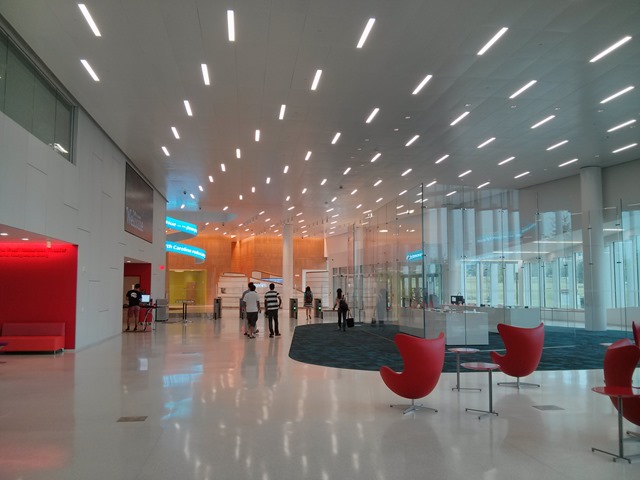 PBS’ new show, , delves deep into some of America’s most outstanding new buildings. Episode 2 features 3 great libraries, including the Snøhetta-designed at N.C. State. The episode airs tonight (4/10) on UNC-Explorer (TWC 1277, UVerse 36) at 9pm.
Remember, too, that the library still gives free, guided tours which are fantastic. The tours begin at the BookBot viewing entrance and are given at:
- Wednesdays at 9:30 am
- Fridays at 3:30 pm
- Second Saturday of each month at 10:30 am
Note: No tours will be given during Reading Days or Finals, April 24 - May 6.
Beer Garden Coming to Glenwood South
The Hibernian group has submitted plans to the city for a beer garden-type bar. calls for the non-descript 2-story building at 614 Glenwood, next to Harry’s Guitar shop, to be converted into a small bar with a large outdoor patio in the side and back yards. The site will likely offer a neat getaway with good views of downtown.
A Plan for UNC’s Dean Smith Center
From the Vault:
 On Monday the News & Observer’s Andrew Carter about UNC doing a feasibility study about Smith Center renovations. While the university claims the facility is still "first rate", fans and recruits know better. Access to the building is among the worst in the country, seating is cramped, bathrooms are dirty and in disrepair, there are no luxury boxes for revenue generation, and student seating is too far from the court to offer a home court advantage like other teams enjoy. The photo shows the men’s room situation, where those who choose to wash their hands are rewarded with only a frigid trickle of water and empty soap dispensers.
None of this is new, however. In 2000 Tar Heel fans had these same complaints about the then 15-year old Smith Center. I submitted four options (featuring 4 to-scale cutaway diagrams) to then Athletic Director Dick Baddour with only a polite form letter in reply. Unfortunately the only renovations since that time have focused on player and coach areas and lower level chair replacement. Problems with the building remain, and it is good that the university is reviewing options.
Attached is the 2008 gogoraleigh post that reposted the original 2000 plans for renovating the Smith Center. The success of the student section behind the home goal shows that Project 1a is quite feasible, and likely the rest still are.
There once was a snowy night back in the year 2000. As two feet of snow fell on the Triangle, the UNC Tar Heels were to face the Maryland Terrapins in the Dean Smith Center. Weather prevented most ticket holders from attending, so all seating was opened to general admission. The the court was surrounded by screaming students and those at the game said it was "magic" as the Heels upset the Terps. On my twelve-year-old UNC blog, , I posted some ideas for renovating the Smith Center shortly after the game. The plans would allow the court to be permanently surrounded by students while appeasing the building’s donors. (I also sent these to Athletic Director Richard Baddour, but only received a polite form letter in return.) As the Dean Dome completes its 23rd season, not much has changed. The building doesn’t allow the team to get the most support possible. It isn’t a lost cause, though. These same ideas could still be applied to give UNC a better home court advantage. Here is that 2000 article:
Dana’s Smith Center Renovation Plans
As UNC plays its 15th season in the , the debate over student seating rages on. Both of the times in the 15 years that seating has been changed to “general admission”, the court has been surrounded by students, and the players have responded with a resounding performance. This could become the norm for the Smith Center with some easy improvements. Clearly N.C. State has shown with their new arena that placing students, the most active and audible fans, around the court creates an intimate, loud setting in a large venue. Simply reassigning student tickets to the first several rows will not suffice as students usually stand for the entire game. Because the lower level descends to the court surface smoothly, the only way to accommodate standing students without obstructing other lower level patrons is to sink the front rows.
Project #1
 Project #1 focuses on placing students around the basketball court. To date there are two popular solutions floating around. One plan, Project 1a, involves replacing the current collapsible seating in the first 11 rows with lower-rise collapsible seating. Given that the 12th row (the first row of permanent seating) patrons should not have their view obstructed by standing students, there should be a drop-off of 43″ from the 12th to 11th rows. This will allow patrons to see over rowdy students that are up to 6′2″ tall. The first row of permanent seats, unobstructed, would become a premium seat location. This new seating would seat students exclusively, so the quality of the chair is not important. Seat width can be as narrow as the seats upstairs, too, since students won’t be using these seats as much as paying patrons.
While Project 1a is a fairly inexpensive solution, it substantially compromises the students’ view. If the current collapsible seating were removed, there would be a wall about 96″ high just in front of the 12th row. After accounting for a 43″ drop, the new collapsible seating could only be 53″ tall. Given those dimensions,11 rows of collapsible seating would only provide an 8.8 degree rise from the floor. While this is almost 50% steeper grade than the current configuration at N.C. State, 8.8 degrees is still too shallow to enjoy the game to the fullest. Also, these seats would be decidedly inferior to those currently in place for non-basketball events. 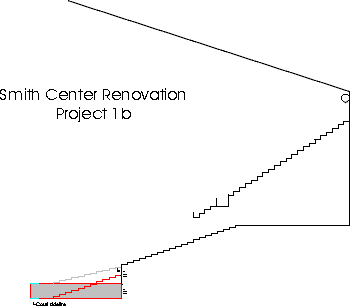
Project 1b replaces the collapsible seating with the best overall aesthetic and functional solution. In this plan the collapsible seating and Smith Center playing surface would be removed and the floor would be excavated 82″ down. A new floor and collapsible seating would be installed.
This new, lowered section of collapsible seating would ascend not at the current 15 degree angle, but at the 20 degree angle seen in the permanent rows of the lower level. Keeping this 20 degree angle is essential to preserving the views of the students and the ticket-holders in those seats for non-basketball events.
In either plan the permanent aisles would not be confluent with the new fold-back seating, so the aisles would have to be reconfigured in at least 4 places so that students in lower rows could access the concourse. While the removal of the existing fold-back risers and the reconfiguration of a few aisles would remove several seats, the new seating arrangement would put nearly 2800 students in the first 11 rows lining the court providing the rowdiest, most intimidating home-court atmosphere in the nation.
Projects 2, 3, and 4 outline several ideas concerning the addition of luxury suites to the Smith Center. While luxury suites can ease UNC’s budget, they also can offer some incentives for lower level patrons to give up the seats affected by Project #1.
Project #2
 Project #2 involves replacing the current suites and seats under the second level overhang with luxury suites. These suites would be replete with 8 leather seats overlooking the playing surface, a countertop for bar and food service, a television, and a private bathroom.
Fifty-two such luxury suites could be placed with ease in the Smith Center. () There would be two non-adjoining suites at the top of sections 127, 126, 125, 124, 121, 118, 117, 116, 113, 110, 109, 108, 107, 104, 101, 100, 133, and 130. Single suites would top sections 123, 122, 120, 119, 115, 114, 112, 111, 106, 105, 103, 102, 132, 131, 129, and 128. Each suite would need to be about 15 feet deep (from the back of the second row of leather seats to the concourse door). In order to accommodate the addition of the suite, approximately five rows (Z, AA, BB, CC, DD) of current seating would need to be removed (shown in grey).
Project #3
 Project #3 involves the construction of a “halo” ring of luxury suites. Due to the design of the Smith Center, the only way to achieve this is to essentially build a structure resembling a ring of Kenan Stadium press boxes. These suites could actually be as large as desired, but are portrayed in the illustration as being 15′ deep. These suites would contain all the amenities mentioned in the lower level suites, but also would have a private concourse and elevator service to the Bowles Room. As shown in the diagram, about 3 rows of current seating (rows W, X, and Y) would be sacrificed to the 2 rows of leather luxury seats.
Clearly the view from a halo box is inferior to all others in the arena, so some incentives would need to be offered. First class wait service and food of the quality level of the Carolina Club would be offered. Halftime and final game statistics would also be delivered to each suite. Pampering the patrons in the halo boxes is an absolute must, though, in order to fill such suites.
Project #4
 Project #4, the most aggressive plan, focuses on placing luxury suites in the bottom of the upper level. Certainly the edge of the upper level is a cherished view, and these such suites would be even more cherished. In order to accommodate a suite in this prime location, a massive overhaul of the Smith Center would have to occur. Because rows E, F, and G and the vomitories would be removed, a separate, third level concourse for rows H through Y would have to be built over the current concourse. Stairways, restrooms, and concession stands would be placed in exterior additions to the existing Smith Center structure.
The second level suites would get their own concourse which would overlook the first floor (existing) concourse. These suites would have four rows of luxury seating, accommodating 32 patrons. Because the upper level ascends at an unbroken 34 degree rise, there would be an uncovered portion approximately 14′ 7″ deep. Some privacy could be offered by mounting an awning (shown as a heavy read line) at the end of the suite’s ceiling. Two private restrooms may be needed in these suites.
Certainly the Smith Center is one of the finest college venues in America, however some improvements could make the Heels more formidable at home. Clearly what is best for the team is placing the students around the court. As we saw in UNC’s game against Maryland and in all of N.C. State’s home games, students give a major boost to the team. While surrounding the court with students will make games more lively, those holding seats on the first 11 rows will have to be displaced. Surely there will be resistance to reassignment from some Smith Center donors. However plenty would minimally sacrifice their seat location in the name of improving the arena’s atmosphere. It is time for everyone involved to do what is best for the University.
Atlanta Braves Shun Downtown, Transit with Stadium Announcement
 Today the Atlanta Braves announced that they will leave the 16-year old Turner Field and build a new stadium out at the Perimeter (I-285) and I-75. The Braves have played in downtown Atlanta since 1966, but this move will take the team 15 miles away, to Suburbia. According to the Atlanta Journal Constitution, Braves executive Derek Schiller said,
“It’s also important that the access around the stadium … is greatly enhanced (by) having those major road ways — I-75, I-285, Cobb Parkway — and having a whole range of improved access points and ways to get to and from the stadium,” Schiller said. “… We fully believe that the access to the site will be greatly enhanced for our fans. That starts with roadways. Today, most of our fans arrive via car, and getting to this (new) site via car from all sorts of different directions is easier.”
Roads roads roads. Meanwhile in Raleigh city leaders are quietly doing long-range planning for a replacement for the 14-year old PNC Arena. A replacement isn’t coming in the next decade or two, however downtownist leaders, bemoaning the suburban location of the suburban arena, are considering just which downtown site would work best for the city. These same leaders are also pushing forward with plans to install a rail system which, supporters say, will spur rail-oriented development foci around the system’s stations.
What will probably be ignored as “stupid Atlanta”, a phrase mentioned frequently by Raleigh planners, is that the Braves, a private organization, are planning to spend $675 million on a facility that could not be farther away from transit and still match the . Atlanta has 48 miles of heavy rail that directly accesses its airport, and one of the city’s most important businesses for Tourism is running away as fast as it can.
So, here is the question: will Raleigh continue to seek an Atlanta-level rail system? Will Raleigh continue to believe that it has some different quality that would make its rail attractive to development and the entertainment industry, unlike Atlanta? Does Raleigh really have what it takes to not exactly mimic Atlanta’s failures?
Aloft Set to Elevate Hillsborough Street
 About 10 years ago the City of Raleigh began the process of restoring Hillsborough Street near NCSU. The street, once a revered college strip of business, restaurants and bars, had fallen into economic malaise as Centennial Campus and the residences of students migrated south of campus. About $13 million later, the street finds itself cleaned up, however the economic climate has been slow to follow.
That all changed with the announcement of an , set to replace Sadlacks and the strip that includes SchoolKids’ Records, two thriving, organic businesses that survived a tumultuous streetscape project. The two have found new homes (Berkeley Cafe and Mission Valley, respectively). Hopefully the West Raleigh community is set to embrace a much-needed hotel that, frankly, will be an exciting upgrade to Hillsborough Street both functionally and architecturally.
The preliminary plans show the hotel containing 135 rooms in a single 7-story building. There will be about 6,500 square feet (2 parcels) of street-level retail space that are better-suited to the pedestrian experience than the current buildings. Most likely the second level will contain Aloft’s branded WXYZ hotel bar with a balcony. Behind and under the hotel there will be 99 parking spaces and a tiny pool.
The exterior of the building will be a superb addition to the street. The Hillsborough St. side will appear like two separate buildings, likely to stay consistent with the pattern of buildings on the street that are “1-store” wide. According to (pdf) (which gives more detail than posted by TBC), the left half will be brick and feature columns of windows sets of varying widths. The center stepback section will highlight the building’s entrance with a building-tall sculpture. The right side, though, will be covered with insulated light gray metal panels and feature color cathode lighting at some of the window trims. The design will be the most sleekly modern commercial building in Raleigh, which is appropriate given the hotel’s proximity to the NCSU School of Design.
Raleigh has a Hillsborough Street problem and it has a Starwood Hotels problem. Since the Phase One renovation of Hillsborough Street completed, the street has had trouble gaining the economic footing for which planners hoped. The Aloft project joins the apartment project down at Morgan as well as the coming IHOP project as the first wave of a coming massive overhaul of the street, and it can’t come soon enough.
, one of the world’s largest, has an inexplicably paltry presence in one of the fastest growing areas in the country. There is an Aloft and Sheraton Chapel Hill and a couple of Four Points and the Sheraton Imperial in RTP. However the only other Starwood property in Raleigh is the Sheraton downtown (former Radisson); BIG problem. Though we continue to wait for a Westin property, we will certainly celebrate the arrival of the Aloft, only the second new hotel inside the beltline in 30 years. We need it, and we need it fast.
Grubb Bringing More Apartments to Lake Boone Area
 Due to the overwhelming demand for apartment space (as mentioned last week), Gordon Grubb is developing a remote parcel near Lake Boone Trail and the Beltline with 3 medium-sized apartment buildings. The project, named (pdf), will be tucked into existing woods behind the Palms Apartments. The project will only replace about 28,000 square feet, a small portion, of the Palms Apartments, but will add 5X the space in 143 units.
Apartment Complex Coming to Glenwood/Oberlin
 Good news, Raleigh. Your worst building, the Kip-Dell Homes office at Glenwood and Oberlin is finally coming down, soon! This week the Raleigh Appearance Commission will consider another addition to Raleigh’s booming apartment market.
The 2600 project will contain roughly 150 apartments in a six-story complex that will replace both the Kip-Dell office and the neighboring U-shaped, brick apartment building. That site and height will be ample for some excellent views overlooking the Carolina Country Club golf course from the north-facing upper floor units. The complex is being developed by Gordon Grubb, and the architect is J Davis (as if you can’t tell from that rendering).
The decision to develop the property with apartments was apparently an easy one for Grubb, as I recently learned that the 290-apartment complex replacing Balentine’s received over 6,400 applications. While apartment projects around St. Mary’s, Hillsborough Street, and Oberlin are rocketing upward, we can probably expect more and bigger project announcements in the coming year (especially around Crabtree).
It will be interesting to see if the plans for the 2600 project will cause as much angst in the community as we’ve seen historically with that property. Around 1983 Guest Quarters announced plans to develop the site with a suite hotel of an approximately similar size to the planned 2600. Neighbors and Carolina Country Club members posted yard signs and used all available political clout to eventually cause Guest Quarters to cancel the project.
This is 2013, however, and the political climate in Raleigh and in the club are different. A different generation is in charge at the club, and the top ranking members have strong real estate backgrounds. Grabbing the popcorn…
Hunt Library is American Architects Project of the Week
This year American-Architects.com is profiling one building per week, each from a different state. This week the survey reaches North Carolina, and NCSU’s Hunt Library is the feature project. features some of the background and goals felt were important in the design process.
The Hunt Library is open to the public. begin at the Floor 1 entrance and are at the following times:
- Wednesdays at 9:30 am
- Fridays at 3:00 and 4:00 pm
- Second Saturdays at 10:30 am
Red Hat’s Latest is a Bad Sign
Red Hat has removed the scaffolding to reveal its bold, red sign atop its new headquarters in downtown Raleigh, and, eh….oh dear. First of all, I’ll admit to being biased by saying that I liked the that topped the building in the Progress Energy era. It not only gave the building some much needed asymmetry, but it also complemented the outlines of the taller buildings on Fayetteville Street, especially when viewed from the south.
The new, rectangular bright red facade atop the building is eye-catching, but only in its garish amount of bright red which stands in stark contrast to every physical structure in downtown Raleigh. It’s as if Red Hat got a waiver on the city’s unusually harsh sign ordinance. I’m sure the CityGate Real Estate owners who are being assaulted not by both the joe schmoes of the Twitterverse and by city councilors for CityGate’s street level video signage, are taking due notice. BB&T and PNC Bank, with their little bitty tower-top signs, are probably also noticing.
Not only is the sign “not in keeping with the neighborhood”, the logo’s vertical alignment is too low in the red billboard to be fully seen from the south (see photos). Whether exiting Memorial Auditorium or entering the city from South Saunders Street, there is no good place to view the sign due to its layout.
Hopefully Red Hat will notice the problems with their sign and correct it. I’m all for tasteful signage, and don’t want a bad sign to cause a knee-jerk response from lawmakers that would would restrict the good signs.
[slideshow id=21]
Recent Stories
- 2014: The Rain Year January 2, 2015
- Tupelo Honey Sets New Casual Standard December 1, 2014
- 2013 Predictions. A Look Back November 18, 2014
- Wicked Taco Bringing Fresh-Mex to Western Blvd November 17, 2014
- DOT Unveils I-440 Widening Plans November 12, 2014
- County Power Shift Brings Major Changes to Raleigh’s Future November 5, 2014
- Jarrett Bay Store Coming to Crabtree September 25, 2014
- FirstWatch Coming to Glenwood Avenue September 9, 2014
- Big Shindig Releases Set Times September 5, 2014
- Appearance Commission to Review Residence Inn September 3, 2014
- Raleigh to Host Farm Aid July 24, 2014
- Download the Wake County Schools’ 2015 Calendars July 22, 2014
- Edison Office Tower Heads to Appearance Commission July 15, 2014
- NCSU Unveils New Basketball Court Design June 26, 2014
- 4-Story Mixed Use Planned For Hillsborough St. June 3, 2014